Overview
This project investigates heat transfer in a long tubular light bulb. The bulb was selected because it naturally includes several important heat‑transfer mechanisms: internal heat generation in the filament, conduction through the gas and glass envelope, and combined convection and radiation from the outer surface to the surroundings. To make the analysis tractable, the real three‑dimensional geometry is idealized as a two‑dimensional longitudinal half‑section of the bulb and base.
The simplified bulb cross‑section is modeled using a 15‑node finite‑difference mesh with equal spacing in both coordinate directions. This nodal network provides a representative sample of the filament, air gap, and glass regions, and allows the governing energy balance equations to be written in finite‑difference form and assembled into a matrix system for solution in MATLAB.
Nodal Model and Regions
The finite‑difference mesh is shown in Figure 1. Nodes are grouped into regions that represent the main physical parts of the bulb:
Filament region (red nodes): uniform volumetric heat generation
Air gap region (green nodes): conduction through the gas surrounding the filament
Glass region (black nodes): conduction through the glass envelope and support structure
Boundary conditions are applied to represent how the bulb interacts with its surroundings:
Left/base boundary: constant temperature to represent the bulb base and socket
Bottom boundary: symmetry along the horizontal centerline of the bulb
Exterior boundary: combined convection to ambient air and radiation to the environment
Source region: uniform internal heat generation applied to the filament nodes
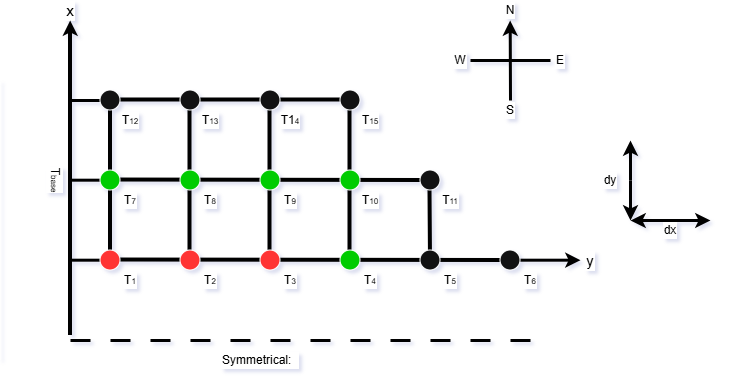
Figure 1 - 15 Node Finite-Difference Model of a Tubular Light-Bulb
Modeling Assumptions and Properties
To keep the model manageable and consistent with course objectives, the following assumptions are used:
Two‑dimensional longitudinal half‑section of the bulb
Constant material properties within each region
Uniform volumetric heat generation in the filament region
Conduction‑only model in the air gap
Equal node spacing in the dx and dy directions
Steady‑state conditions for the Part II 2‑D analysis
Material thermal conductivities k (W/m·K) are specified for each region (filament, air, and glass) and are used consistently in the finite‑difference energy balance equations and in the MATLAB implementation.